A laser is a highly concentrated beam of light at a single wavelength. At each wavelength of light, various materials absorb, reflect, and transmit that light in varying amount.
The laser beam is a column of very high intensity light, of a single wavelength, or color. In the case of a typical CO2 laser, that wavelength is in the Infra-Red part of the light spectrum, so it is invisible to the human eye. The beam is only about 3/4 of an inch in diameter as it travels from the laser resonator, which creates the beam, through the laser cutter's beam path. It may be bounced in different directions by a number of mirrors, or "beam benders", before it is finally focused onto the plate. The focused laser beam goes through the bore of a nozzle right before it hits the plate. Also flowing through that nozzle bore is a compressed gas, such as Oxygen or Nitrogen.
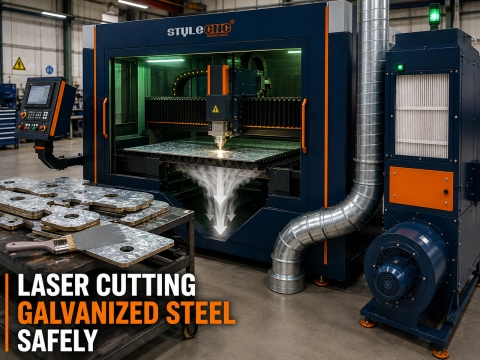
The high power density results in rapid heating, melting and partial or complete vaporizing of the material. When cutting mild steel, the heat of the laser beam is enough to start a typical "oxy-fuel" burning process, and the laser cutting gas will be pure oxygen, just like an oxy-fuel torch. When cutting stainless steel or aluminum, the laser beam simply melts the material, and high pressure nitrogen is used to blow the molten metal out of the kerf.
On a laser cutting machine, the laser cutting head is moved over the metal plate in the shape of the desired part, thus cutting the part out of the plate. A capacitive height control system maintains a very accurate distance between the end of the nozzle and the plate that is being cut. This distance is important, because it determines where the focal point is relative to the surface of the plate. The cut quality can be affected by raising or lowering the focal point from just above the surface of the plate, at the surface, or just below the surface.
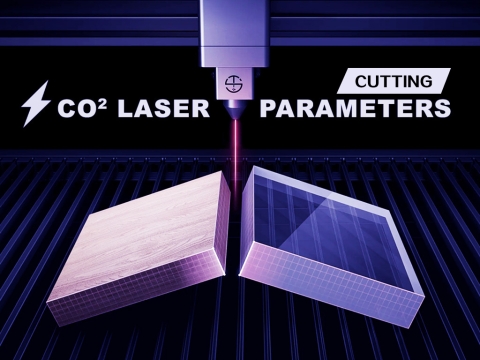
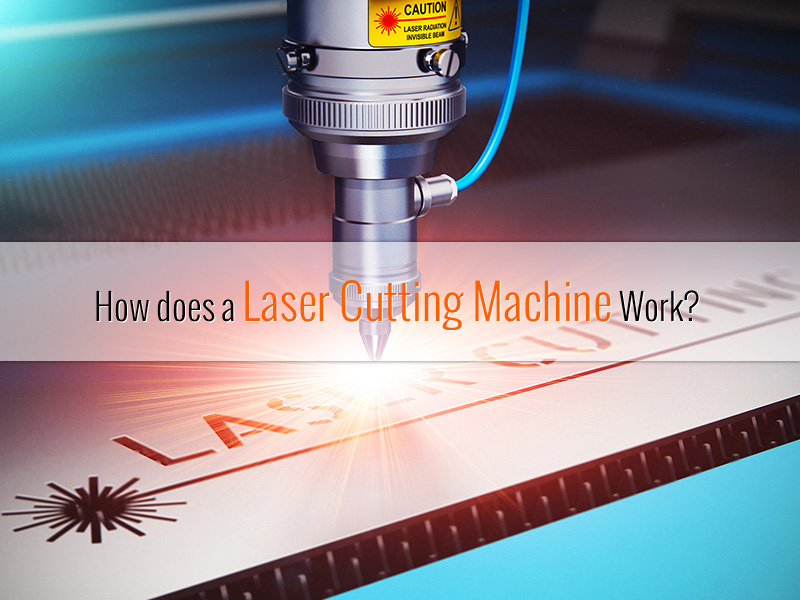
A laser cutting machine works by focussing a beam of laser light onto a piece of material. The laser light is so high powered, that when focused, it raises the temperature of the material to be cut high enough to melt or vaporize the material, in the small area the beam is focused. Often, an assist gas is used to help push the molten material from the cut area. This is especially true for cutting metals or thick sheets of material like plywood.
To cut shapes, the laser head is moved, using some form of gantry to position the beam over new material, causing a line to be cut instead of a small pinhole. The types of motion systems include rack and pinions, ball screws, and linear motors. Linear motors are most expensive, but are fastest and most accurate. Rack and pinions provide nearly the same speed and accuracy, but for a lower price. Some small hobbyist lasers might also use timing belt and stepper motors to move their laser head. In all cases, a system with serves, and encoder feedback adds greatly to the accuracy of laser cutting system, as does a rigid frame, isolated from vibration.
For a laser cutting operation, it's important to choose a wavelength that is highly absorbing in the material you intend to cut.
As the laser energy is directed at the material surface, the material absorbs so much energy that it rapidly heats past its melting temperature and up to its degradation temperature.
At the degradation temperature, the material breaks down and disintegrates. Often, smoke or fumes are released when this happens.
The edge of the cut may be heated to a lower level and actually melt and reform. This can actually be used as a sort of sealing mechanism that is useful for fibrous materials, for example, to prevent threading.
When laser cutter working, it can be a good idea to angle the laser such that smoke from the cutting process does not collect as soot on the laser optics. Additionally, when cutting (or welding) highly reflective surfaces it's important to prevent the laser beam from reflecting off of the surface and back into the laser optics, which can damage them.