A major Machine Tools World feature in late May 2026 confirmed what shop owners already sensed: five-axis machining has moved from a specialty option to a core capability. The technology now sits at the center of high-value manufacturing, and the numbers back the hype. If you sell tooling, fixtures, or accessories, this is the segment to watch.
Why Five-Axis Machines Are Taking Over
A three-axis machine moves a cutting tool in three linear directions: X, Y, and Z. A 5-axis machine adds two rotary axes, letting the tool or workpiece pivot to almost any angle in a single setup.
That extra freedom is why aerospace and medical shops rely on five-axis machining. Complex curved surfaces, deep pockets, and angled features that once required multiple setups are now cut in one operation.
The Core Advantages
• Single-setup machining: Parts are completed in one fixturing, cutting handling time and alignment errors.
• Superior surface finish: Continuous tool orientation produces smoother contours with less manual finishing.
• Tighter tolerances: Fewer setups mean fewer chances for misalignment on precision parts.
• Shorter tools, less vibration: Tilting the head allows shorter, more rigid tooling and faster, cleaner cuts.
These benefits explain the rapid adoption across industries. Explore the full range of five-axis CNC machines to see how multi-axis motion handles aerospace, mold, and sculpture geometries.
The Market Numbers: A Segment Growing Twice as Fast
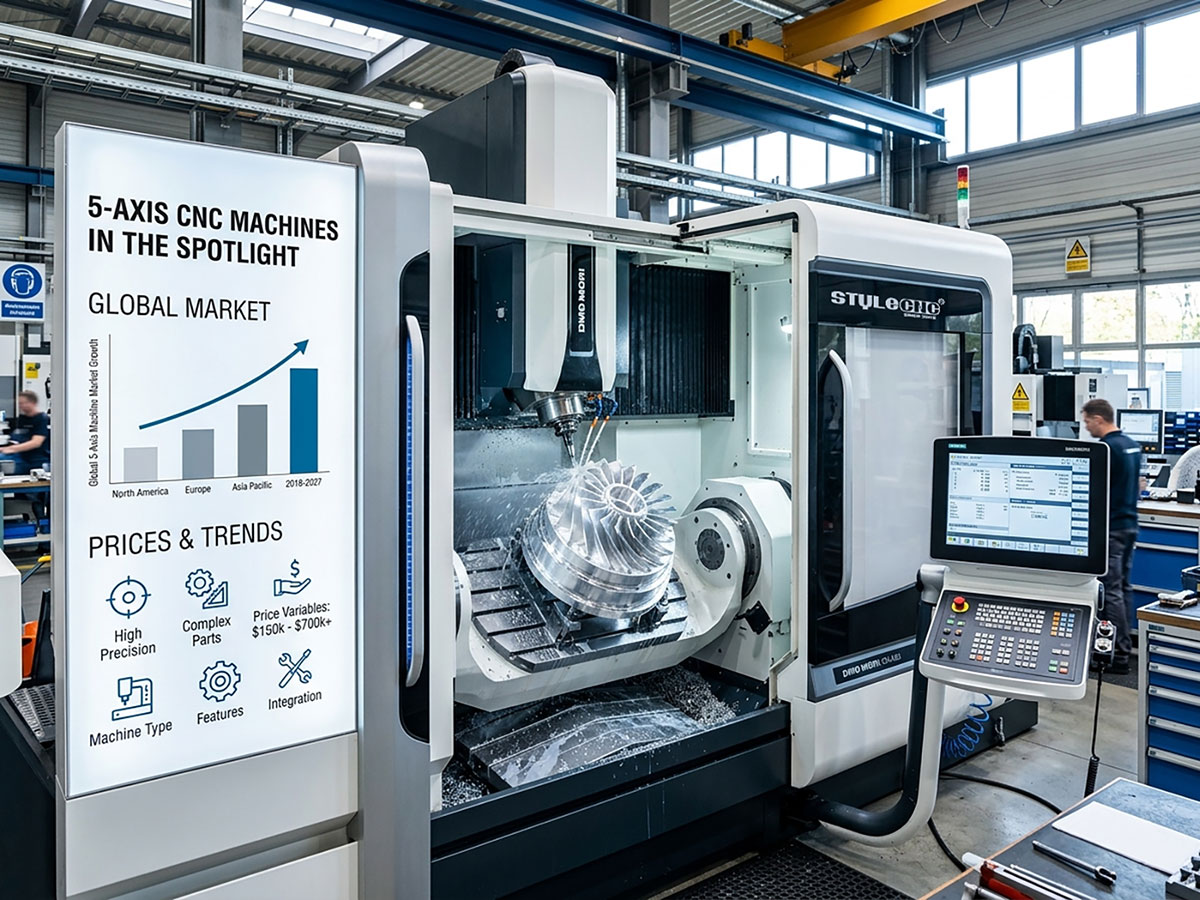
The five-axis segment is outpacing the broader CNC market, which itself is expanding past $110 billion in 2026. While the overall machine tool market grows at roughly 7 percent annually, 5-axis is on a steeper curve.
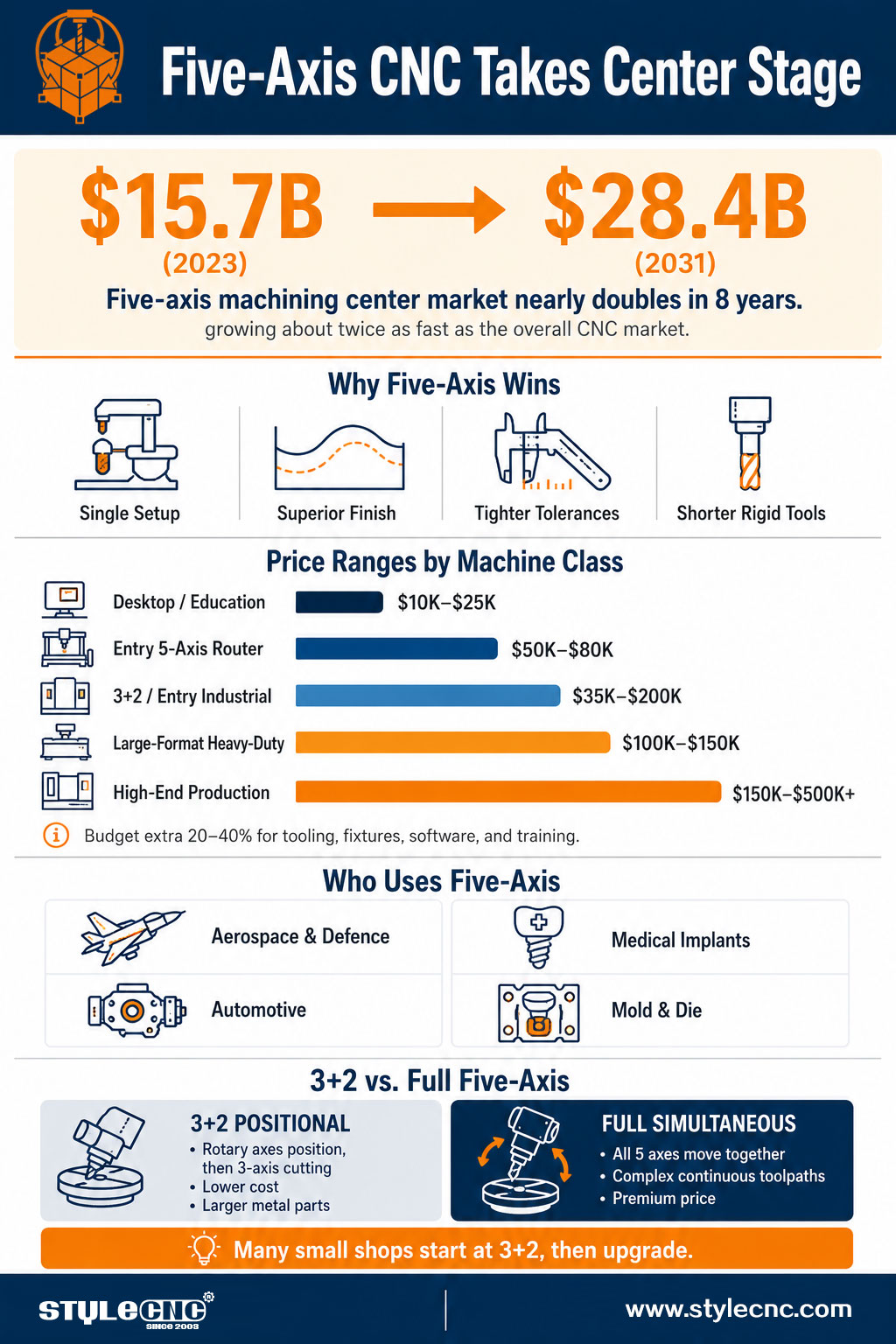
• 2023 five-axis machining center market value: $15.7 billion.
• 2031 projected value: $28.4 billion.
• Roughly an 81 percent increase across the period.
• Primary demand sectors: aerospace, medical implants, defence, and mold making.
• Growth rate: approximately double the overall CNC market average.
Higher average selling prices are part of the story. Because five-axis machines cost far more than three-axis equipment, the segment pushes total market value up even when unit volumes grow modestly.
Five-Axis CNC Machine Price Ranges
Five-axis pricing spans a wide range depending on size, rigidity, spindle power, control system, and automation. Use the table below to frame a realistic budget by CNC machine class.
| Machine Class | Price Range | Best For |
|---|---|---|
| Desktop / Education | $10,000–$25,000 | Prototyping, R&D, training, small soft-material parts |
| Entry 5-Axis Router | $50,000–$80,000 | Wood, foam, aluminum, composites; molds and sculptures |
| 3+2 / Entry Industrial Center | $35,000–$200,000 | Positional 5-axis work, small-batch metal parts |
| Large-Format / Heavy-Duty | $100,000–$150,000 | Industrial manufacturing, large molds and panels |
| High-End Trunnion / Production | $150,000–$500,000+ | Simultaneous 5-axis aerospace and medical production |
STYLECNC entry-level five-axis CNC routers start around $50,000 and include SYNTEC or OSAI controllers with CAM software, while large-format industrial models reach $100,000 to $150,000. For metal-focused work, a five-axis CNC milling machine delivers the rigidity needed for precision aerospace and mold parts.
What Drives Five-Axis Pricing
Two machines with the same axis count can differ in price by a factor of ten. These are the factors that move the number:
| Measurement | Impact on Price |
|---|---|
| Work envelope / size | Larger travels and heavier frames raise cost significantly |
| Spindle power & speed | High-power, high-RPM spindles add to both price and capability |
| Simultaneous vs. 3+2 | True simultaneous 5-axis costs far more than positional 3+2 |
| Control & CAM software | Advanced controllers (SYNTEC, OSAI, Heidenhain) increase price |
| Automation & ATC | Tool changers, pallet systems, and robots add tens of thousands |
| Accuracy & rigidity | Tighter tolerances demand better build quality and higher cost |
Beyond the sticker price, budget for tooling, workholding, and operator training. To understand why premium machines command their prices, read our explainer on why industrial CNC machines are so expensive.
Five-Axis Applications Across Industries
Understanding where five-axis machines earn their keep helps explain the segment’s rapid growth. Each major industry leans on a different strength of the technology.
Aerospace and defence: Turbine blades, impellers, structural brackets, and titanium components demand the compound angles and tight tolerances that five-axis machining delivers in a single setup.
Medical: Orthopedic implants, surgical instruments, and dental prosthetics require organic, freeform surfaces and biocompatible materials machined to exacting standards.
Automotive and motorsport: High-performance engine parts, intake porting, and complex fixtures benefit from the flexible tool orientation that reduces setups and improves finish.
Mold and die making: Deep cavities, undercuts, and curved cores are machined with shorter tools and fewer repositions, improving accuracy and surface quality.
For metal mold and die work, a dedicated 5-axis CNC milling machine provides the rigidity and spindle power these demanding applications require.
Three Affordable Ways to Enter Five-Axis
You do not need a half-million-dollar machine to start. Shops moving up from three-axis have three practical entry paths, each with its own trade-offs.
• Desktop five-axis: True simultaneous motion on small, soft-material parts. Ideal for prototyping, education, and R&D at $10,000 to $25,000.
• Entry five-axis router: A strong choice for wood, foam, aluminum, and composites, including molds and sculptures, starting around $50,000.
• 3+2 machining center: Positional 5-axis that handles larger metal parts and tougher materials, bridging the gap to full simultaneous machining.
Many small shops find that a 3+2 setup is the sweet spot, delivering most of the 5-axis advantage at a fraction of the cost of a full simultaneous production machine. As volume and complexity grow, upgrading to simultaneous five-axis becomes easier to justify.
The Opportunity for Tooling and Accessory Sellers
Every five-axis machine sold creates years of downstream demand. The higher the machine value, the larger the supporting ecosystem around it.
✓ Specialized tooling: Short, rigid tools and angled holders designed for 5-axis motion.
✓ Five-axis workholding: Trunnion fixtures, zero-point systems, and rotary vises that exploit full tool access.
✓ CAM software and post-processors: Complex toolpaths require advanced programming tools and training.
✓ Maintenance and spares: Rotary axes, encoders, and spindles drive recurring service revenue.
The installed base is expanding fastest in aerospace and medical hubs, making accessories a reliable recurring market. A compact small five-axis machining center is often the entry point for shops adding their first simultaneous five-axis capability.
How Buyers Are Researching Five-Axis Machines
These conversational queries reflect what real buyers are asking as they evaluate the jump to five-axis:
• "Why are 5-axis machines so much more expensive than three-axis?"
• "Is a 3+2 machine good enough, or do I need full simultaneous five-axis?"
• "Can I get a real 5-axis machine for under $20,000?"
• "How much does five-axis tooling and workholding add to the budget?"
• "Which industries actually need 5-axis machining?"
Common Mistakes When Buying Five-Axis
• Confusing 3+2 with simultaneous five-axis: Positional machines cost less but cannot cut continuous complex toolpaths.
• Budgeting only for the machine: Tooling, fixtures, software, and training can add 20 to 40 percent to the total.
• Overbuying capability: A desktop or entry router may be enough for prototyping and soft materials.
• Ignoring service and support: 5-axis machines are complex; a strong service partner protects uptime.
• Underestimating programming: Five-axis CAM has a learning curve that affects ramp-up time and output.
Frequently Asked Questions
How big is the five-axis CNC market?
The 5-axis machining center segment was worth $15.7 billion in 2023 and is projected to reach $28.4 billion by 2031, roughly doubling in eight years and growing about twice as fast as the overall CNC market.
How much does a five-axis CNC machine cost?
Prices range from about $10,000 for desktop units to over $500,000 for full production systems. Capable entry-level machines commonly fall between $50,000 and $150,000.
Why are five-axis machines more expensive than three-axis?
They add two rotary axes, more complex controls, advanced CAM software, and higher build rigidity. This raises both the price and the range of parts the machine can produce.
What is the difference between 3+2 and full five-axis?
In 3+2 machining, the two rotary axes position the part before cutting, then the machine cuts in three axes. Full five-axis moves all axes simultaneously for continuous complex toolpaths.
Which industries use 5-axis machining the most?
Aerospace, medical implants, defence, automotive, and mold making rely on 5-axis machines for complex geometries and tight tolerances that other machines cannot achieve efficiently.
Is a five-axis machine worth it for a small shop?
If your work involves complex parts or high-value contracts, yes. Entry routers and small machining centers let smaller shops access five-axis capability without industrial-scale budgets.
Step Into Five-Axis with STYLECNC
As five-axis machining moves to center stage, the right machine is a lasting competitive edge. Explore STYLECNC 5-axis CNC machines and CNC machining centers, or follow the latest in our CNC industry news to stay ahead of the market.